Ayushman Bharat comprises of four components:
The first component pertains to creation of 1,50,000 Health and Wellness Centres (AB-HWCs), now renamed as Ayushman Arogya Mandir, by upgrading the Sub Health Centres (SHCs) and rural and urban Primary Health Centres (PHCs), in both urban and rural areas, to bring health care closer to the community. These centres aim to provide Comprehensive Primary Health Care (CPHC), by expanding and strengthening the existing Reproductive & Child Health (RCH) and Communicable Diseases services and by including services related to Non-Communicable Diseases (common NCDs such as, Hypertension, Diabetes and three common cancers of Oral, Breast and Cervix) and incrementally adding primary healthcare services for mental health, ENT, Ophthalmology, Oral health, Geriatric and Palliative care and Trauma care as well as health promotion and wellness activities like yoga.
Comprehensive Primary Health Care (CPHC) through Ayushman Arogya Mandir – Ayushman Bharat aims to holistically address health (covering preventive, promotive, curative, rehabilitative and palliative care), at primary, secondary and tertiary level by adopting a continuum of care approach. In the lifetime of an individual, the primary healthcare services cater to 80- 90% of the healthcare needs for improved healthcare outcomes and quality of life of the population.
The Primary Health Care team ensures that community outreach and population enumeration are done for individuals in their catchment area and screened for communicable diseases and non-communicable diseases for early detection and timely referral for accurate diagnosis. The team further ensures that treatment adherence and follow-up care are provided to the patients in the community. The essential health services along with the provisioning of essential medicines and diagnostics are provided closer to the community through these centres, as a step towards building stronger and resilient primary healthcare systems which cater to the healthcare needs of the population.
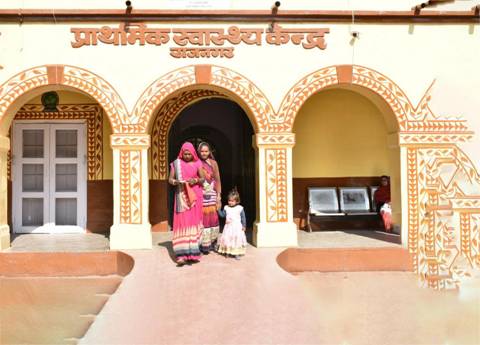
Achievement and Service Delivery at Ayushman Arogya Mandir:
- As on 30.11.2025, 1,81,873 Ayushman Arogya Mandirs (AAM) have been operationalized with expanded package of 12 services and teleconsultation facilities available with footfall of 494.71 crore and 41.93 crore teleconsultations.
- Till date, 39.50 crore screenings have been done for hypertension and 36.70 crore screenings done for diabetes. Similarly, there have been 32.40 crore screenings for oral cancer, 15.23 crore screenings for cervical cancer in women and more than 8.37 screenings for breast cancer in women.
- Further, as on 30th November, 2025, over 6.54 crore Yoga/wellness Sessions have been conducted in operational Ayushman Arogya Mandir.
b. Ayushman Bharat PM-JAY:
- The second pillar of Ayushman Bharat is the Pradhan Mantri - Jan Arogya Yojana (AB PM-JAY), the largest publicly funded health assurance scheme in the world which provides health cover of Rs. 5 lakhs per family per year for secondary and tertiary care hospitalization.
- Currently, 12 Crore families are covered under the scheme. Many States/UTs implementing AB PM-JAY have further expanded the beneficiary base, at their own cost, for their state/UT scheme.
- Approximately 37 lakhs ASHA, AWWs, and AWH were included under AB PM-JAY scheme from February 2024.
- As of 1st December 2025, approximately 42.48 Crore Ayushman Cards have been created since the inception of the scheme.
- As of 1st December 2025, a total of 10.98 crore hospital admissions amounting to Rs. 1.60 lakh crores have been authorized under the scheme.
- As on 1st December, 2025, a total of 32,574 hospitals including 15,532 private hospitals are empanelled under AB PM-JAY to provide healthcare services to scheme beneficiaries.
- AB PM-JAY has ensured gender equity in access to healthcare services. Women account for approximately 49% of the total Ayushman cards created and approximately 48% of total authorized hospital admissions.
- On 29th October 2024, Prime Minister launched “Ayushman Vay Vandana card” under which all senior citizens of age 70 years and above will be provided all the benefits of AB PM-JAY irrespective of their socio-economic status. It is estimated around 4.5 crore families constituting around 6 crore individuals will be covered through this expansion of AB PM-JAY. 94,19,515 people have already enrolled for Ayushman Vay Vandana Card so far.
- An Android based ‘Ayushman App’ has been launched by National Health Authority wherein self-verification feature for beneficiaries has been enabled. The app has been developed using latest technology and provided different modes of authentication i.e. face-auth, OTP, IRIS, and fingerprint for Ayushman Card creation. This ensures that any mobile device can be used for Ayushman card creation.
- The Ayushman Bharat PM-JAY was expanded to Delhi and Odisha in 2025 after an MoU with the states.
c) Pradhan Mantri Ayushman Bharat Health Infrastructure Mission (PM-ABHIM):
The third pillar is the Pradhan Mantri Ayushman Bharat Health Infrastructure Mission, PM-ABHIM) with an outlay of about Rs. 64,180 Cr. It was launched by Prime Minister on 25th October, 2021, to be implemented during the scheme period from FY 2021-22 to FY 2025-26. This is the largest pan-India scheme for strengthening healthcare infrastructure across the country. The measures under the scheme focus on developing capacities of health systems and institutions across the continuum of care at all levels viz. primary, secondary and tertiary and on preparing health systems in responding effectively to the current and future pandemics/disasters.
The Pradhan Mantri Ayushman Bharat Health Infrastructure Mission targets to build an IT enabled disease surveillance system by developing a network of surveillance laboratories at block, district, regional and national levels, in Metropolitan areas & strengthening health units at the Points of Entry, for effectively detecting, investigating, preventing, and combating Public Health Emergencies and Disease Outbreaks.
Increased investments are also targeted to support research on COVID-19 and other infectious diseases, including biomedical research to generate evidence to inform short-term and medium-term response to COVID-19 like pandemics and to develop core capacity to deliver the One Health Approach to prevent, detect, and respond to infectious disease outbreaks in animals and humans.
The budget allocation under this mission is in addition to the National Health Mission (NHM).
Under the CSS components of the scheme, provision has been made for:
The Construction of 17,788 Building less Sub-Centres as Ayushman Arogya Mandir’s and 11,024 Health & Wellness Centres in Urban areas with a focus on slum and slum like areas are envisioned under the scheme during the period 2021- 22 to 2025-26. Further, 3382 Block Public Health Units (BPHUs) at the block level, establishment of 730 District Integrated Public Health Labs in the country, wherein each district will have one such lab. All the Districts with more than 5 Lakhs population will have 50 to 100 bedded Critical Care Hospital Blocks and remaining districts will have referral linkages.
The Current status of CSS component: Under the scheme (excluding XV-FC share), total financial allocation for the State/UTs during the scheme period (2021- 2026) is Rs. 34,932.27 Crore. Under the Centrally Sponsored Scheme (CSS) component of PM-ABHIM, administrative approval has been accorded to the States/UTs for an amount of Rs. 32,928.82 Crore for construction/ strengthening of 9519 Sub-Health Centres AAM, 5456 Urban AAM, 2151 Block Public Health Units, 744 Integrated Public Health Labs at District level and 621 Critical Care Blocks (CCBs) so far.
Setting up of 150 bedded Critical Care Hospital Block (CCHB) has been approved in 12 Central Hospitals under PM-ABHIM viz. AIIMS - Bhopal (Madhya Pradesh), Bhubaneswar (Odisha), Jodhpur (Rajasthan), Patna (Bihar), Rishikesh (Uttarakhand), Raipur (Chhattisgarh), IMS-BHU, AIIMS New Delhi, PGI Chandigarh, JIPMER Puducherry, RIMS Imphal and NEIGRIHMS Shillong.
The proposed 150 bedded CCHB includes emergency complex, intermediate care and HDU, isolation-special category Ward, Intensive Care Unit, Isolation Rooms- Burns ICU & HDU, Operation theatre complex, etc. which are at various stages of implementation. Standard Equipment List for 150-Bedded Critical Care Hospital Block (CCHB) under PM-ABHIM has been formulated.
d) Ayushman Bharat Digital Mission-ABDM:
The Ayushman Bharat Digital Mission (ABDM), launched in September 2021, is an initiative of the Government of India aimed at building a citizen-centric interoperable digital health ecosystem. With ABDM, citizens can securely store and access their medical records (e.g., prescriptions, diagnostic reports, discharge summaries) and share them with healthcare providers after their consent. This enables the creation of a longitudinal health history, ensuring continuity of care. Citizens will have access to accurate and verified information about health facilities and service providers. Through these initiatives, ABDM aims to make healthcare more accessible.
The core components of ABDM’s technological architecture include four registries for providing a trustable identity across healthcare stakeholders in the ecosystem: Ayushman Bharat Health Account (ABHA) for citizens, Healthcare Professional Registry (HPR), Health Facility Registry (HFR) and the Drug Registry. Additionally, three gateways facilitate seamless healthcare information exchange ensuring interoperability: Health Information Consent Manager (HIE-CM), the National Health Claims Exchange (NHCX), and Unified Health Interface (UHI).
No comments:
Post a Comment