Sunday, January 4, 2026

Department of Atomic Energy Year End Review 2025

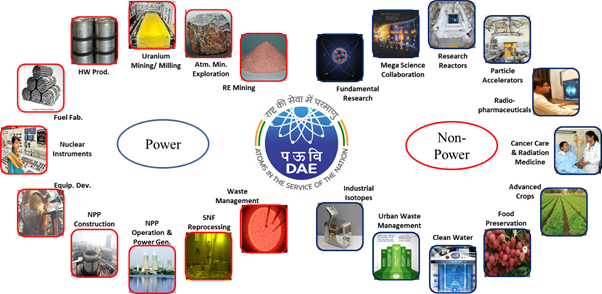
 Department of Atomic Energy (DAE) has continued to deliver on its mandate of producing nuclear power, capacity building for nuclear power, creation and operation of research reactors and particle accelerators for radio-isotope and radio-pharmaceutical production, application of radiation technology solutions to address societal issues in areas of health care, food security, water & waste management. The Department also contributes towards National Security.
  • Hon’ble Prime Minister has laid the foundation stone for the 4-unit Mahi Banswara NPP in Rajasthan on 25th Sept, 2025; to be deployed by NPCIL-NTPC JV, named ASHVINI
  • Unit 7 at Rajasthan (RAPP-7), connected to Northern Grid and started commercial operation.
  • NPCIL crossed the milestone of 50 billion Units (BUs) generation in a financial year for the first time in its entire operation history.
  • Atomic Energy Commission (AEC) has given approval for pre-project activities for an additional 10 units of 700 MWe PHWRs; over and above the 22.5 GW capacity planned by 2032.
  • The 150-bed Homi Bhabha Cancer Hospital and Research Centre, Muzaffarpur, Bihar, was inaugurated by the Hon’ble Prime Minister of India.
  • IAEA has recognised Tata Memorial Hospital as a “Rays of Hope” Anchor Center.
  • Agricultural Radiation Processing Facility (ARPF) has crossed the landmark of One Crore (10 million) medical devices sterilisation using its indigenously developed 10 MeV, 6 kW Linac for electron beam sterilisation.
  • Indigenously developed Certified Reference Material (CRM) named ‘Ferrocarbonatite (FC) – (BARC B1401) formally released, first such CRM in India and the fourth in the world; crucial for REEs ore mining.
  • DAE has set-up the first Electronics-grade (99.8% purity) Boron-11 Enrichment Facility at Talcher, suitable for semiconductor applications.
  • DAE hosted 18th International Olympiad on Astronomy & Astrophysics (IOAA 2025) in August 2025, more than 300 students and 140 Members from 64 countries participated.

Achievements of DAE in this year are numerous and diverse. A selection of noteworthy achievements is provided below.

Achievements in Indian Nuclear Power Programme:

  • Hon’ble Prime Minister has laid the foundation stone for the 4-unit Mahi Banswara NPP in Rajasthan on 25th Sept, 2025. The project will have four units of PHWR - 700 MW and to be deployed by NPCIL-NTPC JV, named ASHVINI.
  • First two units of the indigenous 700 MWe PHWR at Kakrapar, Gujarat (KAPS – 3 & 4) have received AERB license for regular operation. Rawatbhata Atomic Power Project (RAPP) Unit 7 – the 3rd indigenous 700 MWe PHWR in a series of 16 sanctioned reactors, has started commercial operation on April 15, 2025.
  • NPCIL has achieved the highest generation in its entire operating history – 56,681 million Units of electricity in FY 2024-25, avoiding about 49 million tons of CO2 emissions. Continuous Operation for more than a year has been recorded 53 times so far, with TAPS-3 exceeding its earlier record of 521 days and KKNPP-2 operating more than a year.


Achievements in field of health care:

  • DAE continues to contribute to the indigenous development, commercialization & supply of therapeutic/ diagnostic radiopharmaceuticals and Cancer Care.
  • The 150-bed Homi Bhabha Cancer Hospital and Research Centre, Muzaffarpur, Bihar, was inaugurated by the Hon’ble Prime Minister of India on 22.08.2025.
  • TMC has seen a total of 1.3 Lakhs patient registration in FY 2024-25. Around 5 lakh women at Varanasi, Sangrur, Mullanpur and Guwahati have been screened for Oral, Breast, and cervical cancer.
  • The 30 MeV Medical Cyclotron Facility, Kolkata, continues commercial production of FDG and other radiopharmaceuticals and delivered 371 Ci equivalent doses of radiopharmaceuticals were delivered to hospitals for cancer diagnostics.
  • A novel therapeutic intervention, 177Lu-DOTA-FAPI-2286 Therapy, and five new diagnostic interventions with enhanced precision have been introduced, which are being offered in routine clinical practice, thereby enhancing the scope of patient care. The technology for isotopic separation and enrichment of 176Lu was successfully demonstrated in the indigenous Electromagnetic Isotope Separation Facility.
  • Electron beam-based sterilization facility at Indore, Madhya Pradesh is continuously providing e-beam sterilization services to medical device manufacturers in compliance with ISO standards. In the month of Sept, 2025, the facility successfully completed cumulative sterilization of 1.53 Crore medical devices. The medical devices sterilized here are being exported to more than 35 countries including Germany, UK, Spain, France, Belgium, Italy, Netherlands, Switzerland, Austria, South Africa, Indonesia, Portugal, Czech, and Russian Federation.
  • A High-Intensity Gamma Irradiator with Category II type design, ISOMED 2 was completed in May 2025 to serve healthcare industry for terminal sterilisation of healthcare products. ISOMED 2.0 is the only High Intensity Land Based Stationary Gamma Irradiator in the world today.


Achievements in High Technology Areas (particle accelerators, laser, plasma, cryogenic, quantum, space applications, fusion, internal as well as cyber security)

  • An indigenously developed Certified Reference Material (CRM) named ‘Ferrocarbonatite (FC) – (BARC B1401) was formally released.’ This CRM will play a pivotal role in exploration, extraction and process control for Rare Earth Elements (REEs) ore mining and allied production industries. The developed FC-CRM certifies thirteen (13) REEs (Ce, Dy, Er, Eu, Gd, La, Nd, Pr, Sc, Sm, Tb, Y and Yb) along with six (06) major elements (Al, Ca, Fe, Mg, Mn and P). This landmark achievement represents the first such CRM in India and the fourth in the world.


  • NFC has successfully developed the technology for production of high Residual Resistivity Ratio Niobium ingots and sheets. This material is a critical material required for a range of advanced accelerator programs and is aimed at strengthening India’s capabilities in materials research for critical applications.


  • Towards National Security, ECIL has successfully developed and manufactured Integrated Power & Pyro Relay Units (IPPRU) and Launcher Interface Unit (LIU) for Agni missile Launcher System. Also, Weapon Control System (WCS) for Astra Missile (VL- SRSAM) was successfully tested and interfaced with other on-board systems on an Indian Naval Ship.


  • C4I (Command, Control, Communication, Computers and Intelligence) systems for Shore Based Anti-Ship Missile System (SBASMS) have been integrated and supplied to M/s BrahMos Aerospace Private Limited for export to friendly foreign country. Integration of Vehicle Mounted Radar was undertaken for the first time.


  • Niobium Thermit Production Facility (NTPF), a plant set up by NFC under MoU with Vikram Sarabhai Space Centre (VSSC), Department of Space (DoS) to meet the requirements of Niobium for space programmes has been commissioned. First batch of Niobium oxide has been produced from the plant successfully and handed over to Secretary, Dept. of Space & Chairman, Space Commission.


Achievements in Basic & Directed Research:

  • HWB has achieved a significant milestone in enrichment of Boron-11 of more than 99.8% purity (semiconductor grade) at the Boron Exchange Distillation Facility, HWBF-Talcher. The enriched product has been successfully converted into purified enriched boric acid for subsequent transformation into enriched BF3 gas.


  • IMSc researchers have developed a simple, intuitive, and highly accurate growth model using the Gompertz formula to predict the weight of a newborn. The model requires only four standard foetal measurements from at least three routine ultrasound scans. This breakthrough allows for the early detection of foetal weight deviations linked to risks of neonatal complications and stillbirth, enabling timely clinical interventions.


  • The first run for the dark matter direct search experiment, Indian Dark matter search Experiment (InDEx) has been initiated by SINP at the Jaduguda Underground Science Laboratory to explore the low mass region of dark matter.


Achievements in applications of radiation-based technologies for Agriculture & Food Preservation and spin-offs and technology transfer from non-power applications of nuclear energy for societal benefits.

  • An early maturing mutant banana variety – TBM-9 has been developed and notified in collaboration with National Research Centre for Banana (NRCB), Trichy. An early-maturing Sorghum mutant-variety, with 15-20% higher grain yield, RTS-43, was gazette notified. These has taken the number of varieties released by BARC to 72. Apart from this, 6 previously released BARC oilseed varieties have been now extended for cultivation to additional states.


  • 17 MoUs were signed for setting up gamma radiation processing facilities in private and state government sectors and 6 such facilities were commissioned during this period, taking the total number of such facilities operating in the country to 40. BRIT is supporting these facilities by supplying Co-60 sources and establishing the plant operational parameters.


Recognitions at National & International levels:

  • Indian students, mentored by TIFR, have registered stellar performances at the 5 International Olympiads in Biology, Mathematics, Physics, Chemistry and Astronomy & Astrophysics - 2 Gold and 2 Silver medals in 57th International Chemistry Olympiad (IChO) held in Dubai, UAE; 3 Gold and 2 Silver medals in 55th International Physics Olympiad (IPhO) held in Paris, France; 2 Gold and 2 Silver medals in 36th International Biology Olympiad (IBO), held in Quezon, Philippines; 3 Gold, 2 Silver, and 1 Bronze medal in 66th International Mathematical Olympiad (IMO), hosted at Sunshine Coast, Australia; 4 Gold and 1 Silver medal in 18th International Olympiad on Astronomy and Astrophysics (IOAA), held in India.


  • IREL and ECIL have received the prestigious ‘SCOPE Eminence Award 2022-23 under the category of “Institutional Excellence” and “Other Profit Making / Surplus generating PSU”, respectively. The award was presented by Hon’ble President of India, Smt. Droupadi Murmu, on 29th August 2025 at Vigyan Bhawan, New Delhi.


  • On Hindi Diwas on September 14, DAE has been awarded the Rajbhasha Kirti Puraskar for the second consecutive year.


  • Smt. Sonia Kapoor, Headmistress, AECS-2 Mumbai has been conferred the National Award for Teachers 2025 by the Honourable President of India, a recognition that shines as a testament to the excellence of our faculty.


  • NIRF ranking 2025 has placed HBNI at 7th position in the Research Institution category, 12th position in the University category, and 20th position in Overall category in India. The Nature Index 2024-25 has placed HBNI in the first position regarding publications in Physical Sciences and in the third position for overall publications among all institutions in India.

2025 Year End Review for Department for Promotion of Industry and Internal Trade

 Production Linked Incentive (PLI) Schemes

  • Keeping in view India’s vision of becoming ‘Aatmanirbhar’ and to enhance India’s manufacturing capabilities and exports, Production Linked Incentive (PLI) schemes have been launched for 14 key sectors with an outlay of Rs. 1.97 lakh crore.
  • Actual investment of over Rs. 1.88 lakh crore have been realized till June 2025 across 14 sectors, which has resulted in incremental production/sales of over Rs. 17 lakh crore and employment generation of over 12.3 lakhs (direct and indirect).
  • PLI Schemes have witnessed exports exceeding Rs.7.5 lakh crore with significant contributions from sectors such as electronics, pharmaceuticals, telecom & networking products and food processing.

Startup India initiative

  • Launched by the Government in 2016, Startup India initiative has laid a robust foundation for sustained growth of the startup ecosystem in the country. As on date, a total of 2,01,335 startups has been recognized by DPIIT, and these start-ups have created 21 lakh plus jobs across the country.
  • In the spirit of Nari Shakti, there has been a significant contribution of women entrepreneurs in the transformation of the Indian startup landscape. More than 48% of the recognised startups in India have at least one-woman director.

Open Network for Digital Commerce (ONDC)

  •  ONDC aims at democratising e-commerce in India and is expected to make digital commerce inclusive and accessible for all, unlock innovation for all players in the e-commerce ecosystem and bring out potential benefits for all stakeholders in the e-commerce value chain.
  • ONDC has processed a cumulative of 326 million+ orders as of October 2025. Further, in the month of October 2025, 18.2 million orders have been processed and average daily transactions has reached approximately 5,90,000+.

One District One Product (ODOP)

  • Initiative aims to foster balanced regional development across all districts of the country by selecting, branding, and promoting One Product from each District (One District – One Product) of the country. Over 1240+ products have been identified across 775 districts.
  • PM Ekta Malls provides capital assistance to States for the creation of Unity malls in all Indian States to promote ODOP products. Of the 27 States whose DPR for PM Ekta Mall has been approved, 25 States have issued work orders and construction has started in majorty of States.

Ease of Doing Business

  • To promote Ease of Doing Business (EoDB) across the country, the Department for Promotion of Industry and Internal Trade (DPIIT) is spearheading several key reform initiatives, including the Business Reform Action Plan (BRAP), the B-Ready Assessment, the Jan Vishwas Act, and the Reducing Compliance Burden (RCB) framework.
  • Till date, seven editions of BRAP (2015, 2016, 2017–18, 2019, 2020, 2022, and 2024) have been successfully implemented, and States/ UTs have been assessed accordingly. The results of the seventh edition (BRAP 2024) have already been released. The eighth edition, BRAP 2026, has been formally rolled out on 11 November 2025.
  • Further, to strengthen State Single Window Systems and to enhance transparency, efficiency, and user experience, a comprehensive review was undertaken. Pursuant to this, a detailed guidebook was issued outlining eight essential and five desirable features. This initiative represents a significant step towards creating a more responsive and investor-friendly business environment across the States.
  • In line with the deliberations held during the National Conference of Chief Secretaries last year, the District Business Reform Action Plan (D-BRAP) has also been launched. This transformative initiative enables States to cascade business reforms to the district level, ensuring timely and efficient approvals and services across industrial clusters and local enterprise ecosystems.
  • As part of the Reducing Compliance Burden exercise and based on data uploaded on the Regulatory Compliance Portal, Central Ministries/ Departments and States/ UTs undertook extensive self-identification of burdensome compliances. As a result, more than 47,000 compliances have been reduced as of (till November 2025). Of these, 16,108 compliances have been simplified, 22,287 have been digitized, 4,458 have been decriminalized, and 4,270 redundant compliances have been removed.
  • The Jan Vishwas (Amendment of Provisions) Act, 2023, enacted last year, decriminalized 183 provisions across 42 Acts. Furthering these efforts, the Jan Vishwas (Amendment of Provisions) Bill, 2025, comprising 355 provisions, of which 288 are proposed for decriminalization to promote EoDB and 67 for amendment to enhance Ease of Living, was introduced in the Lok Sabha on 18 August 2025. The Bill, approved earlier by the Union Cabinet, has been referred by the Hon’ble Speaker to the Select Committee, which will present its report by the first day of the next Session.
  • Additionally, under the broader EoDB reform agenda, the Government is progressing towards implementation of centralized KYC and a structured Regulatory Impact Assessment framework, thereby providing further impetus to foreign direct investment and domestic manufacturing.
  • National Single Window System: In November 2025 (till 20th Nov'2025), 11,568 approvals have been granted via the National Single Window System (NSWS) out of a total of 26,504 applications received. Cumulatively, till 20th November 2025, 1175435 approvals have been applied through NSWS and 829750 approvals have been granted.

Logistics:

PM Gatishakti National Master Plan (NMP)

  • Launched in October 2021, PM GatiShakti (PMGS) is a National Master Plan (NMP) for multi-modal connectivity. It integrates infrastructure planning across multiple ministries (roads, railways, ports, aviation, inland waterways, energy, etc.) to reduce silos and avoid duplication.
  • 57 Ministries/Departments have been onboarded on the PMGS. Data layers of these Ministries/Departments have been integrated on the NMP. Ministries/Departments have initiated the usage of the NMP for planning of the infrastructure in their respective sectors. 1700 data layers (731 Ministry data layers & 969 State data layers) of Central Ministries and States/UTs have been uploaded on the GIS-data based PMGS NMP portal.
  • PM GatiShakti NMP platform is now open to the private sector. A Query-Based Analytics Mechanism using the National Geospatial Data Registry (NGDR) as an intermediary platform, with a Unified Geospatial Interface (UGI), has been developed by BISAG-N for private users which will aid infrastructure developers, consultants, project planners and academia/researchers with actionable insights.
  • PM GatiShakti District Master Plan launched in 28 Aspirational Districts covering 26 States is now being extended to all 112 Aspirational Districts. This portal will support districts through Geo-spatial technology-based tools for preparation of Master Plan as well as planning of economic and social infrastructure projects.

National Logistics Policy (NLP)

  • NLP launched on 17th September 2022, to drive economic growth and business competitiveness of the country through cost-effective logistics network.
  • To address sector-specific needs in the logistics sector and streamline the movement of bulk and break-bulk cargo in the country, Sectoral Plans for Efficient Logistics (SPEL) are being developed by user Ministries. Sectoral Plans for Coal sector has been notified. SPEL for cement sector has been approved and SPEL for steel, pharma, fertilizer, food processing and food & public distribution is under advanced stage.
  • To bring a holistic focus on ‘logistics’ in public policy at the State level, States/UTs are developing State Logistics Plans (SLPs) aligned with NLP. So far, 27 States/ UTs have notified their respective State Logistics policies.

Unified Logistics Interface Platform (ULIP)

  • The Unified Logistics Interface Platform (ULIP), developed under the National Logistics Policy, is a digital integration layer that breaks ministerial data silos and facilitates seamless data exchange among stakeholders across the logistics ecosystem.
  • Currently, ULIP has been integrated with 44 systems of 11 ministries via 136 APIs covering 2000+ data fields. More than 1700 companies registered on the ULIP portal, i.e., www.goulip.in. Additionally, 200+ applications have been developed by these companies, leading to more than 200 crore API transactions by industry players. Over 20 States' public distribution systems are leveraging ULIP APIs to streamline crop movement

Logistic Data Bank (LDB)

  • Logistics Data Bank (LDB) system is a single window logistics visualization solution which provides 100% EXIM container movement across India tracking using only shipping container numbers. Currently, LDB covers 18 Ports (31 Terminals), 5800 railway stations through Freight Operations Information System (FOIS).

National Industrial Corridor Development Programme

  •  NICDC is a flagship initiative aimed at developing futuristic industrial cities across India to compete with global manufacturing and investment destinations. It will create employment opportunities and economic growth leading to overall socio-economic development. It focuses on providing multimodal connectivity, resilient infrastructure, and sustainable development aligned with "plug-and-play" facilities. As of now, under the National Industrial Corridor Development Programme (NICDP), the Government of India has approved 20 projects spanning 13 states and 7 industrial corridors.
    • The foundation stone of the Krishnapatnam Industrial Area (KRIS City) in Tirupati district, Andhra Pradesh, was laid by the Hon’ble Prime Minister Shri Narendra Modi on 08 January 2025.
    • The Hon’ble Prime Minister also laid the foundation stone for the Kopparthy Industrial Area and the Orvakal Industrial Area on 16 October 2025, accelerating industrial infrastructure development under NICDP.
    • A total of 430 plots (4,552 acres) has been allotted till October, 2025 in the four completed greenfield industrial node projects (Dholera, Shendra Bidkin, Greater Noida, Vikram Udyogpuri).

Industrial Performance

  • Industrial production as measured by Index of Industrial Production (IIP) expanded by 3.0% during April-September 2025-26 over the corresponding period last year on the back of broad-based growth.

Trends in Growth of Eight Core Industries

  • The Index of Eight Core Industries (ICI) measures the performance of eight core industries, i.e., Cement, Coal, Crude Oil, Electricity, Fertilizers, Natural Gas, Petroleum Refinery Products, and Steel. The Eight Core Industries comprise 40.27 per cent of the weight of items included in the Index of Industrial Production (IIP).
  • The cumulative growth rate of the Index of Eight Core Industries during April-October, 2025-26 is 2.5% as compared to the corresponding period of last year.

IPR Strengthening

  • India has emerged as a global leader in intellectual property (IP), ranking in the top 10 for patents, trademarks, and industrial designs.
  • Among the top 20 origins, patent applications filed by Indian innovators recorded highest growth of 19.1% in 2024, marking the sixth consecutive year of double-digit growth driven by a significant increase in resident filings. In the last decade, domestic patent filings by Indian innovators increased by 425% (12,040 in 2014 to 63,217 in 2024), whereas foreign filings by them increased by 27% (10,405 in 2014 to 13,188 in 2024).
  • India recorded 4th highest Trade mark filing globally, with more than 5.5 lakh Trade Mark applications in 2024, reflecting a rapidly expanding business and brand ecosystem. Over the last decade, trademark filings by Indian residents abroad increased by 125% (9,028 in 2014 to 20,303 in 2024), reflecting India’s expanding international brand footprint.
  • With more than 40k design filing in 2024, India recorded highest growth of 43.2% among to 20 IP offices, climbing at 7th position in 2024 from 11th in 2023. Design filings by Indian innovators abroad increased by 600% over the past decade (368 in 2014 to 2,976 in 2024).
  • More than 2.5 million students reached out in last three and half years through various awareness initiatives including National Intellectual Property Awareness Mission launched in December, 2021, which led to 90% increase in patent filings from Indian educational institutes, from 19,155 in 2022-23 to 36,525 in 2024-25.
  • Embracing digital technology in IP administration and management, launched IP diagnostic tool in regional languages for self-assessment, Open-house portal for grievance redressal, IP Saarthi Chatbot for assistance and guidance, AI-ML based search tool for Trademarks, etc. has made the system more transparent and accountable.
  • India’s rank in the Global Innovation Index (GII) has improved from 81st in 2015 to 38th in GII 2025 ranking amongst 139 economies. The GII report 2025 recognized India as one of the longest- standing over performers, performing above expectation for their level of development for the 15th consecutive year

Project Monitoring Group (PMG)

  • The Project Monitoring Group (PMG) is an institutional mechanism for milestone-based monitoring of large-scale infrastructure projects and for expeditious resolution of issues and regulatory bottlenecks in projects with investments above of Rs.500 crores. PMG under Department of Industry and Internal Trade (DPIIT), Ministry of Commerce serves as a one-stop facilitation destination for public and private investors alike at all stages of project implementation. Prime Minister’s Office appointed PMG as an official Secretariat to Monitoring Group in August 2021.
  • PMG supports all mid and large sized Public, Private and ‘Public–Private Partnership’ (PPP) Projects with fast-tracking of approvals, sectoral policy issues and removal of bottlenecks for expediting project commissioning.
  • In 2025, PMG was upgraded to a structured 5-tier escalation mechanism to ensure issues are addressed at the appropriate level, beginning with the respective Ministry for regular issues and escalating up to PRAGATI for complex issues. This approach streamlines the review mechanism, prevents duplication, and enables higher authorities to focus on critical issues that require their intervention.
  • Total 3,022 projects worth Rs. 76.4 lakh crores have been onboarded on PMG portal till 11th November 2025.
  • Since inception, a total of 8,121 issues in 1,761 projects worth Rs. 55.48 Lakh crores have been resolved. In 2025, from 01.01.2025 to 11.11.205, 403 issues across250 projects worth Rs. 11.04 Lakh crores have been resolved.

Foreign Direct Investment

  • India has achieved a remarkable milestone in its economic journey, with gross foreign direct investment (FDI) inflow reaching an impressive USD 1.1 trillion since April 2000 to June, 2025. India’s total annual FDI inflow has more than doubled from USD 36.05 billion in FY 2013-14 to USD 80.62 billion in FY 2024-25. During 2025-26 (up-to June, 25), India has recorded provisional FDI inflows of USD 26.61 billion up by 17% from last year.
  • Over the last 11 financial years (2014–25), India attracted USD 748.38 billion in FDI—an increase of 143% compared to the USD 308.38 billion received in the previous 11 years (2003–14). Almost 70% of the total FDI inflows were during 2014-25 over the past 25 years (2000-25: USD 1,071.96 billion). These figures underscore India’s emergence as one of the most attractive investment destinations globally.

Friday, January 31, 2025

Tuesday, December 24, 2024

Wednesday, November 20, 2024

Wednesday, March 6, 2024

General Studies 10000+ MCQs

Objective Geography


Monday, March 4, 2024

List of Tiger Reserves


tiger reserves in india 2 64f171e80ddb4
TIGER RESERVEDESCRIPTION
1.BANDIPUR TIGER RESERVE KARNATAKALocated in Mysore and Chamarajanagar districts of southern Karnataka.
Ecological confluence of Western and Eastern Ghats.
Part of Nilgiris Biosphere Reserve.
2.CORBETT TIGER RESERVE (UTTARAKHAND) & AMANGARH BUFFER (UTTAR PRADESH)Located on foothills of Himalayas in Uttarakhand in three districts of Pauri, Nainital & Almora. The reserve spreads over Bhabar and lower Shivalik region with a deep-water table.
Rivers Ramganga, Pallaen and Sonanadi flow through it.
3.KANHA TIGER RESERVE MADHYA PRADESHLocated in Maikala range of Satpura Mountains falling in Mandla and Balaghat district of Madhya Pradesh.
Fauna: Critical as last habitat for highly endangered hard ground Barasingha and saving it from extinction.
4.MANAS TIGER RESERVE ASSAMTiger reserve with largest buffer area among tiger reserves in India.Spreads across districts of Kokrajhar, Chirang, Buxa and Udalguri in North-West Assam. Separated by River Manas from the Royal Manas National Park (Bhutan) in its North.
Separated by River Sankosh from the Buxa Tiger Reserve.
Evolutionarily, it is entry point of tigers into India.
5.MELGHAT TIGER RESERVE MAHARASHTRAMarked with large tracts of hills and ravines in Satpura range.
Flora: Characterized by Dry Deciduous Forest with Teak being the dominant species.
6.PALAMAU TIGER RESERVE JHARKHANDLocated in western part of Chhota Nagpur plateau and spread over two districts of Latehar and Garhwa. Only tiger reserve in the Jharkhand. Forms part of Central Indian Tiger Landscape Complex and its habitat contiguity extends to Sanjay Dhubri Tiger Reserve through Guru Ghasidas National Park, all the way to Bandhavgarh Tiger Reserve.
Three rivers i.e., North Koel, Auranga and Burha flow through it. The area is drought prone with Burha being the only perennial river.
7.RANTHAMBORE TIGER RESERVE
RAJASTHAN
Located at the junction of (Great Boundary Fault) of Aravalli and Vindhyan range. Banas River bounds the Ranthambore Tiger Reserve in the North while Chambal River forms the southern boundary of it.
8.SIMLIPAL TIGER RESERVE ODISHALocated in Mayurbhanj District in northernmost part of Odisha. Derives its name from red silk cotton trees growing in the area. Tribal groups such as Khadia, Mankidia and Lodhas live in around the Simlipal Tiger Reserve. Only home to unique melanistic tiger (Black and Yellow stripes). This is due to a rare genetic phenomenon known as pseudo-melanism, which is characterised by excessive pigmentation of dark colour in the skin of an animal.
9.SUNDARBAN TIGER RESERVE
WEST BENGAL
Sundarbans are the largest deltaic region of the world. The region is named after mangrove tree species ‘Sundari.
Fauna: Tiger, Fishing Cat, Estuarine Crocodile, Gangetic and Irrawaddy Dolphins. Harbours significant population of River Terrapin (Batagur baska). Sundarbans are known as Kingfisher’s paradise with 10 species out of 12 kingfishers found in India.
10.PERIYAR TIGER RESERVE KERALAPTR along with adjoining protected areas form largest tiger conservation landscape in southernmost western ghats, extending over 4000 sq km in Tamil Nadu and Kerala.Spreads across districts of Idukki, Pathanamthitta and Kottayam in Kerala.Two major rivers namely Periyar and Pamba drain the area.Tiger reserve with smallest buffer area among tiger reserves in India.
11.SARISKA TIGER RESERVE RAJASTHANHas unique distinction of succesfully reintroducing tiger after its local extinction.There is no perennial river or water stream. Characterised by Dry Deciduous Forests and Tropical Thorn Forest. Anogeissus pendula (also known as Dhok tree or Button tree) is the dominant tree species in the region.
12.BUXA TIGER RESERVE WEST BENGALLocated in Alipurduar of Jalpaiguri district of West Bengal.
13.INDRAVATI TIGER RESERVE
CHHATTISGARH
Located in Bijapur district of Chhattisgarh. Indravati River forms the boundary of this reserve on the northern and western side. (Indravati is a tributary of Godavari River).Has a small population of Wild Water Buffalos (State Animal of Chhattisgarh, IUCN Status: Endangered), Tiger, Leopard etc.
14.NAMDAPHA TIGER RESERVE ARUNACHAL PRADESHLarge, protected area in Arunachal Pradesh near international border with Myanmar. It is a biodiversity hotspot in Eastern Himalayas. It is located on Dapha bum range of Mishmi hills and Patkai range. The Noa Dihing River crosses it from east to west. Harbors northernmost lowland evergreen rainforests in the world. Namdapha flying squirrel (Critically endangered and endemic to this place)
15.NAGARJUNASAGAR TIGER RESERVE ANDHRA PRADESHLargest core area and largest overall area among all tiger reserves in India.
Located in Nallamalla range, an extension of Eastern Ghats of Andhra Pradesh spread over three districts of Kurnool, Prakasham & Guntur.
Located on southern bank of Krishna River.
16.DUDHWA TIGER RESERVE UTTAR PRADESHLocated on India-Nepal border. Part of Shivalik hills and Gangetic Plains tiger landscape complex in Uttar Pradesh.Comprises of three protected areas: Dudhwa National Park, Katerniaghat Wildlife Sanctuary & Kishanpur Wildlife Sanctuary. Provides habitat for unique species including endangered Rhinoceros (succesfully reintroduced), Bengal Florican (Critically Endangered) & Hispid Hare (Critically Endangered).
17.KALAKAD MUNDANTHURAI
TAMIL NADU
Located in southern Western Ghats and forms part of Agasthyamalai Biosphere Reserve.
Major river: Gadananathi river
18.VALMIKI TIGER RESERVE BIHARLocated in Bihar in northern part of West Champaran district along the border of India & Nepal.Located in Terai region of Himalayas is connected to Chitwan National Park in Nepal.Only Tiger Reserve in Bihar. Sets an excellent example of Shivalik Hills and Gangetic Plains landscape with a mosaic of dense forests, open woodlands, swamps and grasslands.
19.PENCH TIGER RESERVE MADHYA PRADESHLocated on southern slopes of Satpura range in Madhya Pradesh. Pench River flows through the park from north to south and splits the park into two. Meghdoot dam on Pench River is located on the boundary of this Tiger Reserve.
20.TADOBA ANDHERI MAHARASHTRALocated in Chandrapur district of Maharashtra in the Vidarbha region. The Andhari River passes through this reserve.
21.BANDHAVGARH TIGER RESERVE MADHYA PRADESHLocated between Vindhya and Satpura ranges in Madhya Pradesh. The park has remnants of archaeological monuments dating to Kalachuri dynasty.
22.PANNA TIGER RESERVE MADHYA PRADESHNamed after the city of diamonds, Panna in the Bundelkhand region in Madhya Pradesh.Spreads across Panna, Chhatarpur and Damoh districts of Madhya Pradesh. Located in Vindhyan Range.Forms northernmost tip of natural teak forests. Ken River flows through the tiger reserve.
23.DAMPA TIGER RESERVE MIZORAMLocated in western edge of Mizoram. It is bound by Chittagong hill tracts of Bangladesh. Drained by River Khawthlangtuipui in the West and the Teirei River to the East.  
24.BHADRA TIGER RESERVE KARNATAKALocated in Western Ghats of Karnataka. The habitat is drained by Bhadra River and its tributaries.Moist & Dry Deciduous forests and Shola grasslands.
25.PENCH-EXTENSION MAHARASHTRAExtension of Pench Tiger Reserve in Maharashtra.
26.PAKKE TIGER RESERVE ARUNACHAL PRADESHLocated in the foothills of Eastern Himalayas in East Kameng District of Arunachal Pradesh.Forms a transition zone between Indian and Malayan ecoregions and high endemicity.Pakke River forms the boundary in the East while Kameng River forms the boundary in the West.Pakke along with Nameri Tiger Reserve forms one of the largest blocks of semi-evergreen & evergreen forests in North-East.Key habitat for Clouded Leopard
27.NAMERI TIGER RESERVE ASSAMLocated in northern part of Sonitpur district of Assam along the foothills of Arunachal Pradesh. This habitat is rich in biodiversity and is famous for white winged wood duck. It is bound by Jia Bhoreli River in the West and Bor-Dikorai River in the East.
28.SATPURA TIGER RESERVE MADHYA PRADESHPrime example of Central Indian Highlands ecosystem. Pachmarhi is located inside it. Located south of Narmada River.
29.ANAMALAI TIGER RESERVE
TAMIL NADU
Largest tiger reserve of Tamil Nadu. Situated at the heart of Anamalai Range (Also known as Elephant hills).
30.UDANTI SITANADI TIGER RESERVE
CHHATTISGARH
Named after Sitanadi River which originates here and joins Mahanadi River.
31.SATKOSIA TIGER RESERVE ODISHASpread over four districts of Angul, Cuttack, Boudh and Nayagarh in the heartland of Odisha. The Mahanadi passes through this tiger reserve and forms a large gorge here, hence also known as Gorge Sanctuary.
32.KAZIRANGA TIGER RESERVE
ASSAM
Located on the southern bank of Brahmaputra River in the Golaghat and Nagaon districts of Assam.World famous habitat for one-horned rhinoceros. The river Diffalu, a tributary of the Brahmaputra, flows through the National Park area (core/critical tiger habitat), while another tributary Moradifalu flows along its southern boundary.
33.ACHANAKMAR TIGER RESERVE
CHHATTISGARH
Located in the Maikala range in Chhattisgarh. It is located close to Amarkantak, the source of Son and Narmada River.  
34.KALI TIGER RESERVE KARNATAKALocated in Uttara Kannada district of Karnataka in Western Ghats. It was formerly known as Dandeli Anshi National Park. Kali River flows through it.
35.SANJAY DHUBRI TIGER RESERVE
MADHYA PRADESH
Located in Sidhi and Shahdol districts of Madhya Pradesh on the borders of Chhattisgarh (Close of Guru Ghasidas National Park in Chhattisgarh).Various perennial rivers like Gopad, World famous white tigers “MOHAN” was found and rescued from the forest of this landscape by Maharaja of Rewa in 1951.
36.MUDUMALAI TIGER RESERVE
TAMIL NADU
Located in North-eastern and North-western slopes of Nilgiris at the tri-junction of Kerala, Karnataka and Tamil Nadu. Moyar River passes through it. Documentary Movie ‘Elephant Whisperers’ was shot in this Tiger Reserve. Kattunayakan Tribe (PVTG) lives in this tiger reserve.
37.NAGARHOLE
KARNATAKA
Located in districts of Mysuru and Kodagu district of Karnataka. The reserve named after a small river ‘Nagarhole’ (a snake stream in Kannada), which meanders through it, before joining Kabini River.  
38.PARAMBIKULAM
KERALA
Located in Anamalai landscape of Western Ghats in Palakkad and Thrissur districts of Kerala. The park has montane and marshy grasslands locally known as ‘Vayals’ and Evergreen, Deciduous and Shola forests.
39.SAHYADRI MAHARASHTRALocated in Sahyadri range of Western Ghats in Maharashtra. These ranges from a common boundary between Maharashtra, Karnataka & Goa.First tiger reserve of Western Maharashtra and spreads across two protected areas of Koyna sanctuary and Chandoli National Park.
40.BILIGIRI RANGANATHA TEMPLE KARNATAKALocated in Chamarajanagar district of Karnataka. Acts as a bio-geographical bridge between Western & Eastern Ghats in South India.Derives its name from ‘Bilgiri’, the rocky white rocky cliff which has a temple of Lord Vishnu locally known as Rangaswamy.
41.KAWAL TIGER RESERVE TELANGANALocated on the banks of Godavari River and forms part of Deccan peninsula – Central Highlands.Located on the southernmost tip of Central Indian Tiger Landscape, has linkages with Tadoba-Andhari (Maharashtra) and Indravati (Chhattisgarh) tiger reserves.
42.SATHYAMANGALAM TIGER RESERVE
TAMIL NADU
Located as a transition zone between Western and Eastern Ghats in Erode District of Tamil Nadu. It contiguous with other tiger conservation landscapes like BRT, Bandipur, Mudumalai and Nagarhole.
43.MUKUNDARA TIGER RESERVE
RAJASTHAN
Named after two continuous flat topped, almost parallel hills with narrow central ridges forming part of Vindhyas extending from Chambal to Kali Sindh River.
44.NAWEGAON NAGZIRA TIGER RESERVE MAHARASHTRALocated in Gondia and Shandara districts of Maharashtra in Vidarbha region.
45.AMRABAD TIGER RESERVE TELANGANALocated on the Nallamalla hills (part of Eastern Ghats) along Krishna River. Sri Sailam dam on Krishna River is located inside the Tiger Reserve. Mouse Deer (Indian spotted Chevrotain) which were locally extinct is being re-introduced in this protected area.
46.PILIBHIT TIGER RESERVE UTTAR PRADESHLocated in Pilibhit district of Uttar Pradesh on the international border with Nepal. River Gomti originates from this reserve. The park also forms catchment of Sharda, Chuka and Mala Khannot rivers. Sharda Sagar dam forms the boundary of the reserve. Connected to Dudhwa Tiger Reserve through Kishanpur (UP), Shuklaphanta (Nepal) and Nandaur Sanctuary in Uttarakhand. Fauna: Critically endangered Bengal florican and hispid hare.
47.BOR TIGER RESERVE MAHARASHTRALocated in Wardha District of Maharashtra. Located adjacent to Pench Tiger Reserve.
48.RAJAJI TIGER RESERVE UTTARAKHANDLocated in Haridwar, Dehradun and Pauri Garhwal districts of Uttarakhand. The tiger reserve is named after C. Rajagopalachari.  
49.ORANG TIGER RESERVE ASSAMSmallest core area and smallest overall area among all tiger reserves in India. This Tiger Reserve is located on the northern bank of Brahmaputra River in Darrang and Sonitpur districts of Assam.
Home to Indian rhinoceros, Pygmy Hog (Critically Endangered), Elephant, Wild Water Buffalo, Bengal Tigers. (Only stronghold of rhinoceros on North Bank of Brahmaputra). Bengal Florican (Critically endangered) is one of the flagship birds found in the park.
50.KAMLANG
ARUNACHAL PRADESH
Located in Lohit district of Arunachal Pradesh. The Kamlang River passes through this sanctuary, after which this tiger reserve named. It is located on the north of Namdapha National Park. Local inhabitants of the region are Hishmi, Digaru & Mizo. They claim themselves as descendent of King Rukmo of Mahabharat. Home to Four big cats (Tiger, Leopard, Clouded Leopard & Snow Leopard), Hoolock Gibbon, Slow Loris, Leopard Cat, Himalayan Palm Civets
51.SRIVILLIPUTHUR MEGAMALAI
TAMIL NADU
This tiger reserve was created by combining two wildlife sanctuaries Grizzled Squirrel Wildlife Sanctuary and Megamalai Wildlife Sanctuary. This tiger reserve is located close to Periyar Tiger Reserve. Vaigai River originates from this Tiger Reserve and flows to Palk Strait. Meghamalai (also known as High Wavy Mountains) is a mountain range located in Western Ghats in Theni district of Tamil Nadu.
52.RAMGARH VISHDHARI RAJASTHANLies in the southeastern part of Rajasthan.Plays an important role in connecting Ranthambore and Mukundra Tiger Reserves of Rajasthan.
Mez River, a tributary of Chambal River, passes through the tiger reserve.
53.RANIPUR
UTTAR PRADESH
Latest Tiger Reserve to be notified. Located in the Chitrakoot district of Bundelkhand Region of Uttar Pradesh.
This Tiger Reserve has been notified to accommodate sinking of a part of Panna Tiger Reserve due to the Ken-Betwa Linkage.

Indian Rebellion of 1857